Singapore Leave Entitlements 2026: The Employer's Guide (and What NDR 2026 Changes)
28 Aug 2026 · 7 min read · Sparky ⚡
If you employ people in Singapore, leave entitlements are not a policy choice. The Employment Act sets floors for annual and sick leave, the government runs the childcare and parental schemes, and the National Day Rally on 23 August 2026 just announced the biggest change to childcare leave in years. This guide collects what a Singapore employer actually owes in 2026, with every number traced to MOM or MSF, and flags the one thing you should not rewrite your handbook for yet.
A note on scope: this is a practical summary for employers, not legal advice. The linked MOM and MSF pages are the authority; check them before you finalise policy.
The short version
For an Employment Act covered employee in 2026:
| Leave type | Entitlement | Who pays |
|---|---|---|
| Annual leave | 7 days in year 1, rising to 14 from year 8 | Employer |
| Outpatient sick leave | Up to 14 days per year | Employer |
| Hospitalisation leave | Up to 60 days per year (includes the 14) | Employer |
| Childcare leave (child under 7) | 6 days per parent per year | Employer pays days 1 to 3; government reimburses days 4 to 6, capped at $500 per day |
| Extended childcare leave (child 7 to 12) | 2 days per parent per year | Government reimburses, capped |
| Shared parental leave | 10 weeks for babies born on or after 1 April 2026 | Government-funded scheme |
Most entitlements require at least 3 months of service, and several pro-rate for new joiners. The details, and the mistakes people actually make, are below.
Annual leave: 7 days in year one, 14 from year eight
Under the Employment Act, an employee qualifies for paid annual leave after 3 months of service. The statutory floor starts at 7 days for the first year and rises by one day per year of service, reaching 14 days from the eighth year onward.
Two things worth being clear-eyed about:
- This is the legal minimum, not the market. Most Singapore employers offer 14 to 20 days from day one, because 7 days is not competitive for professional hires.
- Whatever you offer above the floor is contractual. The Act governs the statutory portion; your handbook governs the rest, so write the handbook carefully.
Pro-rating annual leave without getting it wrong
For an employee who has not completed a full year, MOM's formula is:
(Completed months of service ÷ 12) × annual entitlement, rounded to the nearest whole day (round up from half a day). Incomplete months do not count, unpaid leave months do not count, and the notice period does count.
Three worked examples on a 14-day policy:
- Joined 1 March, leaving 30 September: 7 completed months. 7 ÷ 12 × 14 = 8.17, so 8 days.
- Joined 15 May, still employed at year end: months count from completion, so 15 May to 14 December is 7 completed months, 8 days accrued so far.
- Joined 1 July on the statutory 7-day floor: 6 ÷ 12 × 7 = 3.5, which rounds up to 4 days.
The mistake we see most: counting calendar months instead of completed months of service, which quietly overstates entitlement for mid-month joiners.
Sick and hospitalisation leave: the 14 and 60 day rules
From MOM's sick leave rules: an employee covered by the Employment Act qualifies for paid sick leave after 3 months of service, provided they inform you (or try to) within 48 hours of absence and are certified unfit for work by a registered medical or dental practitioner.
The full entitlement, reached at 6 months of service, is up to 14 days of paid outpatient sick leave and up to 60 days of paid hospitalisation leave per year. The 60 days is a combined cap: it includes the 14 outpatient days, not on top of them.
Between 3 and 6 months, entitlement steps up: 5 outpatient and 15 hospitalisation days at 3 completed months, 8 and 30 at 4 months, 11 and 45 at 5 months, then the full 14 and 60 from 6 months. Before 3 months, sick leave is unpaid.
Hospitalisation leave is not just for warded stays: day surgery, quarantine required by law, and doctor-certified bed rest (for example pregnancy complications) qualify too.
Childcare leave today: 6 days plus 2, and who reimburses what
Under the Government-Paid Childcare Leave scheme, each working parent of a Singapore citizen child under 7 gets 6 days per year: you pay days 1 to 3, and the government reimburses days 4 to 6, capped at $500 per day including CPF contributions. Parents of children aged 7 to 12 get 2 days of extended childcare leave, government-reimbursed. Entitlements pro-rate by completed months for new joiners, and the days are per parent, not per child.
What NDR 2026 changed, and what we still do not know
At the National Day Rally on 23 August 2026, the government announced that childcare leave will increase to 8 to 12 days per working parent, depending on the number of children, covering children aged 12 and below, with the government bearing the cost of the increase.
What has not been published yet: the exact tiering by number of children, the reimbursement mechanics, and the implementation date. MSF's Pro-Family Leave portal currently carries a banner pointing to the announcement without operational details.
Our advice: brief your managers that the change is coming, but do not rewrite your handbook or your leave system until MSF publishes the details. Announcements set direction; entitlements are defined by the implementing rules.
Shared parental leave: the 10 weeks that started 1 April 2026
For babies born on or after 1 April 2026, shared parental leave reached 10 weeks under the government-funded scheme, on top of maternity and paternity leave. If you employ new or expecting parents, this materially changes coverage planning for small teams: two people sharing 10 weeks looks very different on a 15-person roster than on a 500-person one.
Carry-forward, forfeiture, and encashment: mostly yours to design
The Employment Act protects the statutory minimum entitlement; how generously you handle everything above it (carry-over caps, expiry dates, encashment on exit) is largely policy. The design choices that prevent disputes:
- State a carry-over cap and an expiry date explicitly, in writing. Silence creates expectations you did not intend.
- Say what happens to unused leave at resignation, in both directions: leave owed to the employee, and leave taken in advance.
- Whatever you decide, apply it uniformly. Inconsistency, not generosity, is what creates grievances.
Check the current MOM guidance when you draft this section; the statutory portion has protections that your policy cannot override.
A leave policy skeleton you can adapt
- Annual leave: entitlement, accrual method, tenure increases, carry-over cap and expiry.
- Sick leave: the statutory structure above, plus from which day you require an MC.
- Childcare and parental leave: mirror the government schemes and name who to notify.
- Public holidays: Singapore's gazetted holidays, and your policy when one falls on a rest day.
- Other leave: compassionate, exam, unpaid. Even one line each beats silence.
- Process: where requests go, who approves, and how fast.
Setting this up once, instead of recalculating it by hand
Every rule above turns into arithmetic that someone in your company currently does in a spreadsheet: pro-rating for the designer who joined on the 15th, tracking the outpatient versus hospitalisation split, remembering that childcare days are per parent per year.
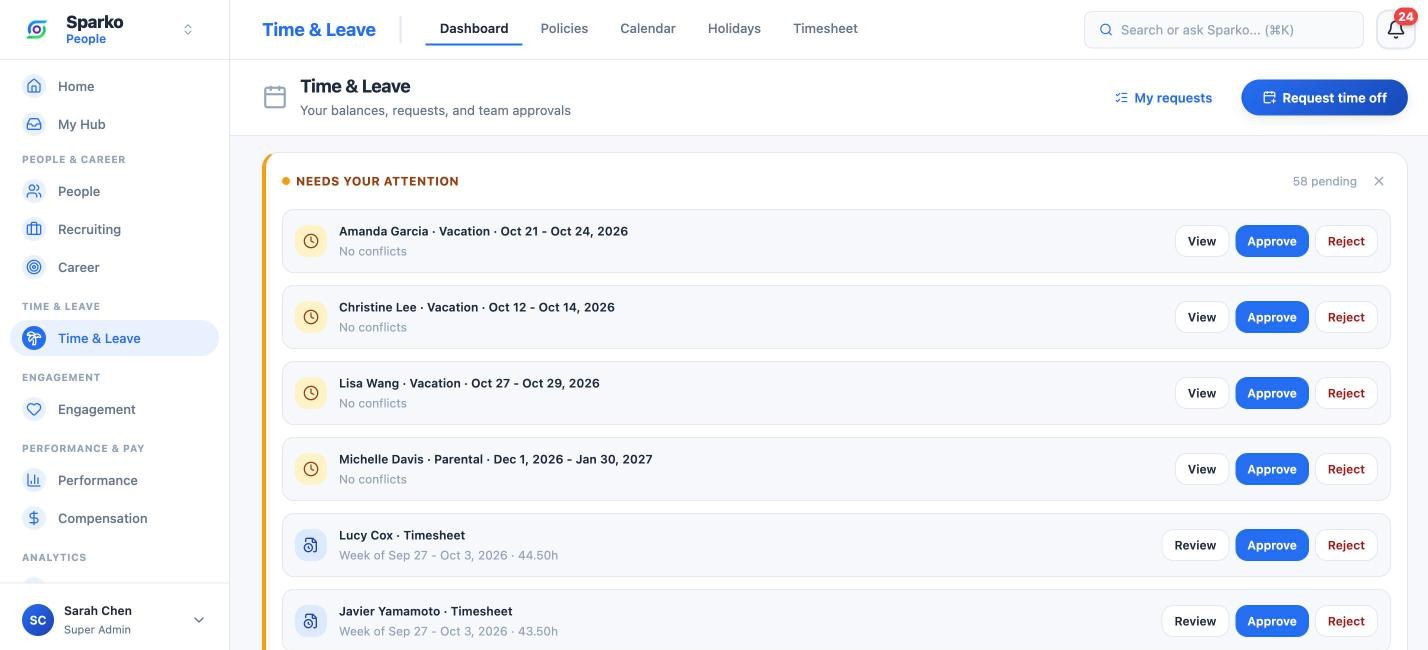
That mechanical layer is what Sparko's time and leave module absorbs: 13 built-in leave types with per-country holiday and work-week proposals in the setup wizard, balances and accruals tracked per employee, approval routing to the right manager, and a team calendar that shows coverage before you approve. It ships on every plan, alongside the same record that runs your payroll, so approved leave and pay never disagree. One honest boundary: Sparko tracks and applies the policy you configure; it does not compute statutory entitlements for you, so the numbers in this guide, and MOM's pages, remain your source of truth.
Set the policy once, point the system at it, and the recalculating stops being anyone's Tuesday.
Sparko is the AI-native HRIS for teams of 5 to 1,000+. Explore the features or see pricing.
← All posts