Performance Reviews for a 30-Person Team: A System That Doesn't Eat a Quarter
23 Aug 2026 · 4 min read · Sparky ⚡
At 10 people, you don't need performance reviews — everyone knows how everyone is doing. At 30, that ambient awareness is gone: managers have appeared, someone feels overlooked for a raise, and a new hire is quietly struggling in a corner nobody watches. This is the point where teams bolt on a review process — and usually overbuild it, copying a big-company ritual that takes managers a full quarter to run.
Here's a system sized for 20–100 people: enough structure to be fair, little enough to actually happen.
Decide what the review is for
A review can serve three purposes: development (what should this person work on), compensation (what should they be paid), and documentation (a record if things go wrong). Small companies get into trouble by pretending one conversation serves all three — the person hearing "here's your growth feedback" is really listening for "so what's my raise?"
The clean split for a 30-person team:
- Development conversations — twice a year, structured, written down.
- Compensation decisions — once a year, after the review cycle closes, informed by it but communicated separately.
- Documentation — falls out of the first two automatically if they're written, which is the real argument for not doing reviews verbally.
Cadence: semi-annual, with 1:1s carrying the load
Annual-only reviews fail at small scale — a year is several product eras at a startup, and feedback delivered eleven months late is trivia. Quarterly formal reviews overwhelm working managers. The workable pattern:
- Every 6 months: a written review cycle (self-review + manager review).
- Every 1–2 weeks: 1:1s where real feedback happens continuously. The written review should summarize what was already said in 1:1s — if a review ever contains a surprise, the 1:1s failed.
- Peer input once a year, on the cycle where comp is decided, so the picture isn't one manager's opinion alone.
The template: four questions, one page
For each person, the manager and the individual both answer:
- What were the goals, and what happened? Tie this to whatever goal system you use (OKRs or otherwise). Outcomes, not activity.
- What's one thing this person does that the team should get more of? Specific strengths, with examples.
- What's the single highest-leverage improvement? One, not five. A review with seven development areas produces zero development.
- What does the next six months look like? Scope change, skill focus, or explicit "keep doing exactly this."
Concrete examples separate useful reviews from horoscope-grade ones. The STAR structure — situation, task, action, result — is the simplest way to force specificity: not "great ownership" but "when the payroll integration broke the week before the run, she found the root cause, coordinated the fix, and we paid on time."
Calibration: thirty minutes that keeps it fair
Once both sides have written, managers (at 30 people, that's likely 3–5 of them) meet once and read across the ratings: is one manager grading systematically harder? Are the two people doing similar jobs rated a level apart for the same performance? Calibration at this scale is one meeting, not a committee season — but skipping it is how small companies drift into pay-equity problems they discover two years later.
Where the hours actually go — and what AI changes
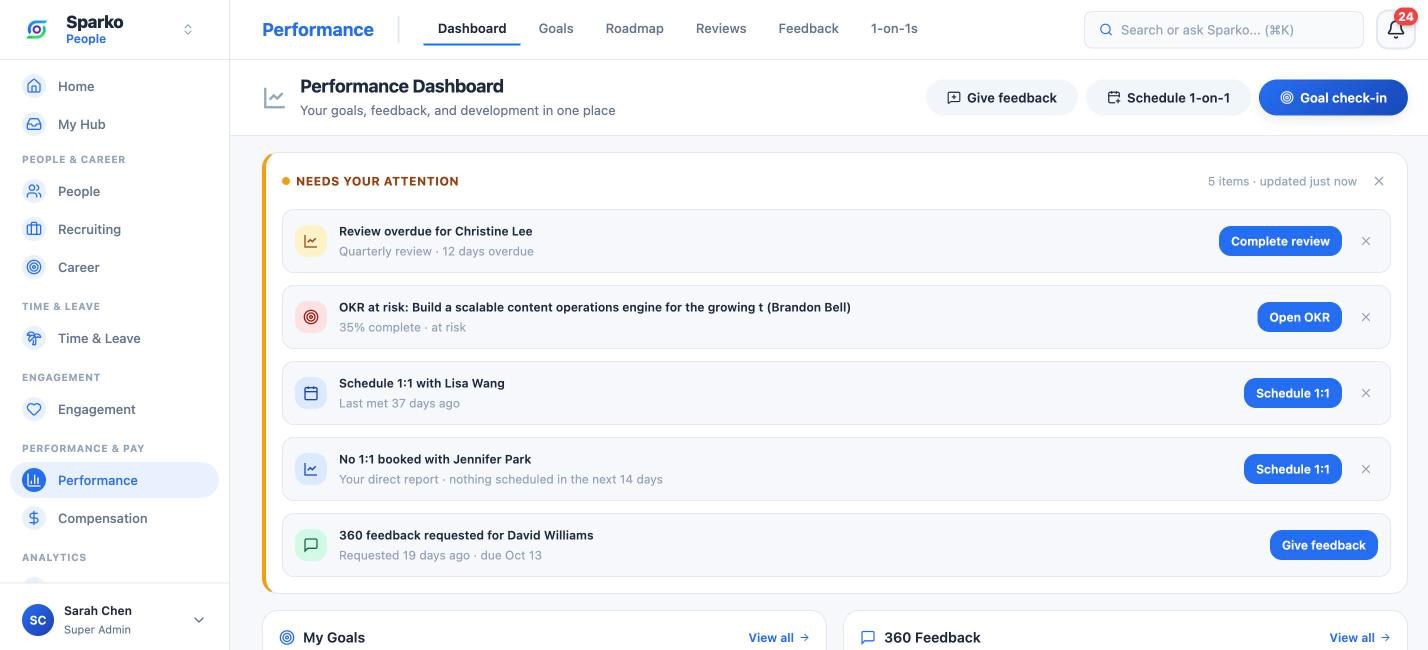
The bottleneck in every review cycle is the same: managers staring at blank text boxes, trying to reconstruct six months from memory. That reconstruction step is exactly what software should do. A manager's raw material already exists — goal progress, 1:1 notes, peer feedback, recognition — it's just scattered.
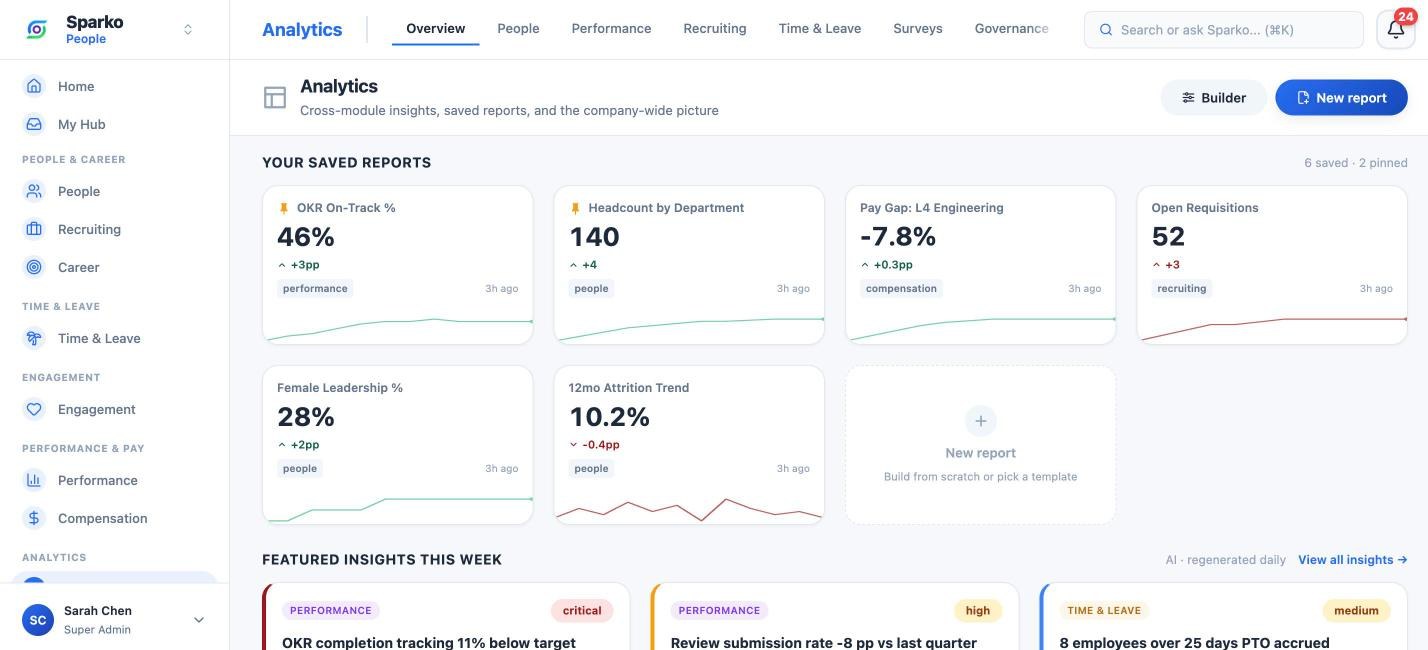 Review context in one place: goal progress, feedback history, and engagement signals, instead of a memory exercise.
This is how Sparko's performance module approaches it: review cycles with self, manager, and 360 stages; and AI that drafts a review from the record — the person's OKR progress and accumulated feedback — in STAR format, for the manager to edit and own. The draft is a starting point a human revises, never an auto-verdict; estimated across a 100-employee company, that drafting step is the difference between a review season measured in weeks of manager time and one measured in days. Every plan includes the module and the AI drafting, from $5 per user per month.
The one-page summary
- Split development from compensation; never let one meeting pretend to be both.
- Written, semi-annual, fed by continuous 1:1s. No surprises.
- Four questions, one page, STAR-specific examples.
- One calibration meeting per cycle, however small the company.
- Let software assemble the record so managers spend their time on judgment, not recall.
A 30-person company doesn't need a big company's process. It needs the smallest process that is still fair — run consistently enough that nobody is guessing where they stand.
Sparko is the AI-native HRIS for teams of 5 to 1,000+. Explore the features or see pricing.
← All posts